INTRODUCTION
I would like to imagine the news media we encounter today through the lens of two words and their etymological paths: news and gospel.
The English word news has a peculiar attribute. According to the Oxford English Dictionary (OED) (n.d.), this word is a plural noun derived from the Latin nova (new things), but after the 16th century, it has acquired usage interpreted as singular (Online Etymology Dictionary, n.d.). This reflects the character of institutional news as we know it, a system that gathers fragmented events from the world and integrates them into a unified order.
The transformation of the word gospel also suggests an interesting point. According to the OED (n.d.), originally meaning “good news,” gōdspel began to misread as a message from gŏd (God) due to an ambiguity of its written form. The OED describes this misreading, “very natural”, as the resulting sense was much more obviously appropriate for a word associated with sacred liturgy. Consequently, the recipient of a gospel message is put in a position where they must listen and accept the message the moment they face its form, regardless of whether its content is actually “good.”
I suggest we overlap these two terms to picture what news does to its audience. News is not merely a medium that delivers information, it is closer to an infrastructure that decides what deserves our attention and, in doing so, shapes how we perceive reality. Today, this power has moved beyond the newsroom to the far more pervasive and powerful algorithmic infrastructure of social media platforms. But it operates differently. While legacy media picks and integrates fragments into a single order, platform algorithms work by breaking that formal unity, providing customized fragments to each person.
As a result, the diagnosis that the current information environment encourages fragmentation and polarization has long become familiar, with terms like “filter bubble” or “echo chamber” commonly used to describe this phenomenon. Internet activist and writer Eli Pariser, who first introduced the concept of filter bubble, warned that platform algorithms isolate users, and proposed reformist solutions around better transparency and user autonomy (Pariser, 2011). Over the past decade or so, this framework seems to have become the standard outline for explaining social phenomenon such as rise of far-right worldviews and conspiracy theories.
But I want to ask whether this familiar narrative sufficiently explains the direction of cause and effect. Whether the fragmentation of our shared reality is solely the result of algorithms capturing us, or rather a byproduct of our own active choices to justify what we already think. I want to explore the idea that we might not be passive victims unilaterally misled by what algorithms feed us. Instead, we might be active architects of our own realities, conveniently choosing our own gospels as tools to back up our own existing convictions. So, rather than focusing on whether the bubble can be “popped”, a metaphor that feels a little too optimistic about its own solution, I want to trace the structural conditions and psychological mechanisms that lead us to sometimes walk into a reality of our own choosing. This thesis explores, largely within the Korean context, the transformation of the media environment, the shocks dealt to our shared reality, and the different patterns of response that followed.
The first chapter traces how the media structures I outlined above took root within Korea's socio-historical conditions and how they have evolved into what they are today. The second chapter examines how our shared reality gets fragmented and distorted. It traces the design logic of platform algorithms, the way we select information as material for justifying what we already believe, and what happens when that material itself is deliberately manipulated, looking at how all of this gets politically weaponized and the different ways it has been resisted and navigated. The third chapter takes these conditions as a starting point, examining attempts to redesign information delivery as dialogue rather than gospel. It asks what changes when who gets to speak changes, and when the structure within which they speak changes.
CHAPTER 1
Nyuseu means nyuseu
According to media studies scholar Kang Joon-mann, Korea's first modern newspaper and broadcasting systems were modeled after Japanese media in the years leading up to and during the colonial period. Early newspapers were closely affiliated with government agencies and avoided direct interpretation or criticism of social reality. Instead, they uncritically accepted Social Darwinism, framing imperialist expansion as an “inevitable process of civilization.” Hansung Shinbo (한성신보, 1895-1906), a prominent early newspaper established with support from the Japanese Ministry of Foreign Affairs, actively introduced modern literary formats like serialized fiction while using its content as a propaganda tool to justify imperial aggression (Kang, 2019).
This pattern of importing foreign media formats repeated after the division of the peninsula, when television news arrived as a fully formed genre from the U.S. Kang(2019) explains the establishment of Korea's first television station, HLKZ-TV(1956-1961), was a product of the commercial interests of the U.S. electronics and media giant RCA, specifically regarding the sale of broadcasting equipment and exclusive receiver rights. The broadcasting format was a direct copy of the U.S. model as well. When KBS TV(1961-present), South Korea's leading public broadcaster, was first launched, it sent workers to the American Forces Korea Network (AFKN-TV, 1957-2012) for technical training, which played a crucial role in cementing the U.S. style media format as the standard for the Korean news broadcasting system. Across these successive imports, the term corresponding to
news was not translated. It's rendered phonetically as
nyuseu(뉴스), which is a direct adoption of the English pronunciation.
However, directly importing these formats did not mean that the theoretical functions of journalism came along with them. These functions were themselves products of a specific tradition of thinking about what journalism should technically serve, developed by Western journalism scholars and elites. Journalist Bill Kovach and media critic Tom Rosenstiel defined the primary purpose of journalism as “providing citizens with the information they need to be free and self-governing” (quoted in Zelizer et al., 2021, ch. 1). Commenting on this, professors of media and communication studies Zelizer, Anderson and Boczkowski note, most scholarly discourse on journalism, going back all the way to 1922, hovers over this point. However, they also observe that scholars and critics have largely “ignored most of journalism’s functioning in non-democratic societies” (Zelizer et al., 2021, ch. 1). In that context, through colonial rule, the Cold War, and one dictatorship after another, Korea lost the opportunity to prioritize these functions. Jung Joon-hee, another media studies scholar, explains that this tendency was repeatedly reinforced through a history of governance that treated media as infrastructure for state administration and social stability. Through a cycle of being suppressed and eventually coaxed by power, the media functioned as part of an “information distribution network” to maintain state system rather than as an independent watchdog.
1 Under these conditions, the media could operate for a long time on the convenient assumption that as long as the format of news was maintained, public trust and efficacy would automatically follow (Jung Junhee eui Hashtag, 2021). However, that assumption has been unraveling for some time.
According to the
Reuters Institute Digital News Report 2023, public trust in news in Korea remains near the bottom among surveyed countries (Nielsen et al., 2023, p.142). Media studies scholars Kim and Shin explain this mistrust as a pattern that “Korean media have treated the audience not as subjects of service to be provided with accurate information as members of a democratic society, but as objects to be actively mobilized for their own political and economic interests.” (Zelizer et al., 2023, p.165) They add that this practice has resulted in the internalizing of partisan logic among the audience, manifesting as polarization where many show unconditional hostility toward media they see as ideologically opposed.
Who informs us now if tree falls in the forest
“If a tree falls in a forest and no one is around to hear it, does it make a sound?”
This well-known philosophical thought experiment has been applied in journalism discourse to illustrate how journalism functions as epistemic infrastructure. For example: if a tree falls in a forest, through what means and under what conditions can that event become real to those who were not there?
For a long time, the practical answer to this question was provided by a single institution. As sociologist Herbert Gans put it, journalism is fundamentally about “deciding what’s news” (quoted in Zelizer et al., 2021, ch. 4). It functioned as a system that decided what had happened, what mattered, and what qualified as an event in the first place. When something “made the news”, it meant that it had crossed the threshold from a private occurrence to a publicly recognizable reality. In this sense, Jung argues that the authority of journalism was built on a practical monopoly over gatekeeping process, the power to set the criteria for what was worth public attention, rather than a mere ability to verify individual facts. Events that are not recognized as news generally remained outside public reality, circulating as rumor or a peripheral knowledge (RohMoohyun Foundation, 2024).
However, events can now be recorded, circulated, and interpreted without passing through a single gate of journalism as we knew it. With smartphones and social media platforms, people can enter the forest simultaneously and capture the moment of a tree falling from their own positions. Some summarize what they saw, some explain it, some react immediately, and some turn it into memes. Under these conditions, the question of what becomes news, or what constructs our shared public reality, is no longer decided exclusively by a single institution. But the question itself seems more urgent than ever. Judgements about what matters, what is happening now, and what demands our immediate response are still being made all the time. Today, where platform algorithms have taken over the gatekeeping power of newsrooms, a tree falling in the forest now makes different sounds depending on the specific orbit of each recommendation algorithm. The public reality once centrally constructed by institutional journalism has fragmented into a multiverse as scattered as the number of YouTube channels out there. Furthermore, the criteria of this new gatekeeper are invisible and practically impossible to hold accountable. As computer scientist Arvind Narayanan (2023) points out, platform companies have shared very little about what their engagement-optimizing algorithms actually do to society, and the algorithms themselves are complex enough that even people inside the platforms can’t fully trace their effects.
Sohn Sukhee, who has held the top spot as South Korea’s most trusted journalist for over a decade, was asked during an interview about the mass migration of journalism contents to YouTube whether he uses the platform himself. He replied that he definitely avoids it, saying it feels like being attacked by algorithms the moment he steps in (SohnSukhee eui Jilmundle, 2024). I thought his response was very much on brand. It sounded like the last sliver of pride of an elite journalist refusing to surrender to a machine the right to decide what matters. But for an ordinary consumer like myself, who can’t afford to have such intense self-consciousness or professional grit, platform algorithms don’t feel like a choice.
Kim Ou-Joon, the most controversial figure in the South Korean media and a consistent second in trust rankings for years, seems to stand at the opposite end of the spectrum from Sohn. His TBS radio news program had the most listenership for five consecutive years before it was cancelled in 2022 under political pressure from those who took issue with its “perceived bias.” Instead of looking for another legacy outlet, he took his show to YouTube. He brought the legacy media formats with him, the newsroom set, regular broadcast schedule. From the very first broadcast he declared that his news delivery would be unashamedly biased around a specific set of values, but that the process leading to those biased conclusions would remain journalistically fair (Kim Ou-joon’s News Factory, 2023). His declaration was well-suited to a free-market platform with no institutional regulators demanding mechanical neutrality, and the strategy targeted a Korean media environment where YouTube usage is higher than in most other countries, pulled in even more viewers who had never used the platform before. By the second day of broadcasting, he had secured nearly 900,000 subscribers.
Within this structure, Kim’s choice turned out to work perfectly. Sticking to legacy media formats even in this territory free from institutional oversight gave his viewers something familiar to hold onto as they made the migration, and kept them watching longer and tuning in on schedule, which is exactly what the platform is designed to reward. The problem is that this reward structure does not work only for Kim. Misinformation and hate content disguised as news are rewarded in exactly the same way. Kim’s successful migration and the mess thriving across the platform both seem to be products of how YouTube operates.
As journalist Mark Bergen(2022) traces, this dynamic goes back to the repeal of the United States’ Fairness Doctrine in 1987. When broadcasters were no longer required to present both sides of an issue, Rush Limbaugh debuted, what Bergen describes as an aggressive “failed disc jockey” who found a way to turn the anger of conservative audience, people who felt alienated by legacy media, into revenue through his call-in radio format. The revenue model, which Rupert Murdoch later described as “talk-radio with video” when defining Fox News, was carried over into the digital world through YouTube’s watch-time-based compensation system. Cenk Uygur, “a liberal, voluble radio veteran” in Bergen’s words, who had been on YouTube since its early days from 2005, recalls that he only saw few conservative shock jocks on the platform until around the watch-time transition, when they “started popping up all over the place.” He adds that these newcomers went beyond the Rush Limbaugh-style of plausible lies into outright fabrication completely detached from reality.
This same dynamic played out in South Korea. The algorithmic platform moved into the trust vacuum left by media that had historically treated audiences as objects to be mobilized and, in doing so, had driven the internalization of partisan logic. What naturally followed was a large scale migration of audiences toward an information environment with no editorial ethics, no institutional oversight, and no clear lines of accountability.
CHAPTER 2
Looking back at the solutions for filter bubble Pariser proposed over 14 years ago, his main point was that we can’t possibly leave our digital environment in the hands of the profit-seeking private actors operating these bubbles. The central problem Pariser identified was that in the fight for control over the internet, every group was organized except for the general public, while those online conglomerates were already lining up to write the rules. He argued that if enough of people speak up, “the lobbyists don’t stand a chance” (Pariser, 2011, ch. 8). For that optimism to work, however, it needed a premise that people had to share the same reality as a majority. They had to be able to recognize the same issues as problems and move in the same direction. But over the past 14 years, platform algorithms seem to have done exactly that, tearing down that premise. Was this inevitable? This chapter uses media theorist Wendy Chun’s work to trace where this design logic came from and how it breaks a majority capable of solidarity and captures them into separate realities. It then moves on to cognitive scientist Hugo Mercier to look at how that capture works not by external influence, but through materials already inside us, and analyzes how, in the South Korean context, this logic combines with state power to reinforce itself like a snake eating its own tail, and how, within that same structure, different movements responded in vastly different ways.
Your Kind
Chun argues that the design logic behind platform algorithms based on data analytics is rooted in the eugenic classification logic of the 20th century. Although the criteria have shifted from strains and physical traits to clicks and digital behavioral patterns, the base logic of collecting, classifying, and surveilling user data while reinforcing the boundaries of similar groups is the same. These algorithms do not treat users as individuals but as entities formed and identified by their “neighbors.” Chun (2021, p.52) states, “For the twentieth-century eugenicists, homophily was an aspiration: they wanted to create a world in which like people automatically reproduced with like. In data analytics, homophily is a given, an axiom.” One of the problems with this logic is that within this structure, individuals end up experiencing only the reality produced and provided by these classifications without knowing which clusters or neighbors they’ve been categorized with.
Chun connects this discussion of homophily with the transgressive hypothesis, to point out that even resistance becomes just another pattern to be classified within the algorithm. Chun explains the transgressive hypothesis as “the notion that individual defiance and difference ground freedom.” It is the belief that condemning mainstream media, thinking differently, and seeking alternative information are acts to be free from oppressive systems. This hypothesis traces back to the post-World War II in reaction to Nazi eugenics and Stalinism. The argument was that since conformity supposedly drove totalitarianism, democracy must be equated with resistance and transgression, anything but the conformity. As Chun (2021, p.76) notes, “If the problem was centralization and corporate control, the solution—we were told—had to be ‘authentic transgression,’ ‘alternative media’—anything that could build the world anew. Everything ‘alternative’ was ‘progressive,’ from music to schools to community structures.”
However, Chun argues that this logic has backfired. The constant call to be different, to never be fooled by what we see and to choose something alternative, the attempt to step outside dominant conventions and discourses by “being the red-pilled” or seeking reverse hegemony has failed to automate democracy. Instead, “it fostered populism, paranoia, polarization and the new biometric eugenics” (Chun, 2021, p.77). In the end, the transgressive hypothesis mimics the same totalitarian world view it sought to resist. Chun draws on Arendt to describe where this leads to a state where “the modern masses no longer believed ‘in the reality of their own experience’ and no longer trusted ‘their eyes and ears but only their imaginations’” (quoted in Chun, 2021, p.76).
Chun (2021) also shows how this type of resistance feeds directly into the structures designed by algorithms in the current media environment. The moment you think you’re resisting, homophily algorithms capture that behaviour and group you with other similar resisters. Then that’s hardly liberation, it seems more like a migration into an even narrower reality that deepens segregation and accelerates the dissolution of shared reality.
So I have to ask, is the problem then resistance itself? Within a structure where algorithms capture every movement and reinforce segregation, does every attempt to look for an alternative inevitably lead to a migration to an even narrower reality? As I will cover in more detail later, over the past few years I’ve watched things move in very different directions on these same platforms. Some people seem to move toward an increasingly narrow version of reality, where information coming from outside reads as if it’s manipulation, and only what circulates within feels true. But others used these same platforms to respond to what was happening in front of them in fairly systematic and collective ways. If those two different dynamics played out within the same structure, the platform is not what made the difference. Mercier gives a way to reframe the question: under what conditions do the platform algorithms capture us?
One of Mercier’s (2020) strongest arguments is that we are not as gullible as we might think. When we encounter new information, we don’t simply accept it. We have a mechanism that automatically evaluates incoming information against the beliefs and knowledge we already have, which Mercier calls “plausibility checking”. To explain this mechanism, Mercier draws on evolutionary logic. Because there’s always an incentive to send unreliable signals between communicating individuals, natural selection has developed “a whole suite of cognitive processes—mechanisms of open vigilance—that minimize our exposure to unreliable signals and, by keeping track of who said what, inflict costs on unreliable senders” (Mercier, 2020, p.28). This mechanism is always at work, which is why changing people’s minds at scale through external messaging turns out to be extremely difficult. Mercier (2020, p.113-145) draws on a range of research to show that historically, the repeated messaging and emotional appeals used by demagogues, preachers, propagandists, and advertisers have been surprisingly ineffective at actually changing what people think. This is reassuring. We have this cognitive mechanism, which means we are not simply accepting whatever platform algorithms keep showing us. But as Mercier points out, the problem with plausibility checking lies in the pre-existing materials it works with. If we evaluate new information against existing beliefs, then those existing beliefs become the decisive factor. According to Mercier, popular misconceptions and conspiracy theories tend to spread precisely because they are intuitively powerful. He writes, “Far from being due to widespread credulity, the prevalence of intuitive misconceptions reflects the operation of plausibility checking, when it happens to work with poor material”(Mercier, 2020, p.62). He takes the anti-vaccine movement as an example. The reason misinformation about vaccines spreads is not that people are fooled by fake news. There is already an intuitive resistance to the idea of injecting pathogens into the body, and that intuition acts as the material, which is why anti-vaccine information already feels plausible. So the mechanism is functioning as usual. The problem is the material.
When the pre-existing materials are distorted, plausibility checking does not filter out that distortion. And as Chun shows, algorithms are optimized by design to reinforce this kind of poor material. But what happens if the material itself was deliberately engineered? Journalist Peter Pomerantsev documents actors who intentionally design and activate these materials, while using the same language and tactics as resistance movements fighting against authoritarianism to achieve the opposite result. The goal of this kind of operation is not to persuade someone with individual messages, but to make a specific belief appear as the majority opinion through collective accounts. Researchers at Oxford University have called this process “manufacturing consensus.” Such operations have been repeated across various countries, including Serbia, Estonia, and Mexico (Pomerantsev, 2019, ch. 2). What makes this an effective strategy is that it targets the very material plausibility checking relies on. Plausibility checking evaluates new information against existing beliefs, and as Mercier (2020) shows, what appears to be majority opinion is one of the inputs that shapes those beliefs. Then manufacturing consensus is contamination of the material itself.
Futhermore, the work of polarization expert Bart Brandsma helps to understand why this kind of manufacturing consensus is such a foul strategy. Brandsma first draws a distinction between conflict and polarization. Conflict is defined by a specific place, a specific time, and specific problem owners. It is possible to identify who is involved, what happened, and where. Whereas polarization operates on a principle Brandsma calls “thought construction.” It transforms the same conflict into something untethered from place or time, with no clear locus of responsibility, made up of drifting words, opinions, and ideas. The moment an event that can be named, attributed, and held accountable is converted into abstract, fragmented opinions about the identity of a particular group, it becomes something intangible. Take Brandsma’s examples: “refugees are fortune seekers”, or “right-wing voters are uneducated egoists”. These opinions take no specific event, no identifiable actor, no person to hold accountable. The target of response disappears, all that is left is emotional reaction (Brandsma, 2025, ch. 1).
In South Korea, this operation of manufacturing consensus also occurred systematically at the state level. In 2000, as the internet first opened up to the public in South Korea, a voluntary grassroots movement emerged online. Three years later, it delivered something nobody had seen coming, the election of an underdog progressive candidate to the presidency, who had been largely dismissed by the mainstream media. In the following years, this online grassroots movement drove the expansion of progressive politics within a political environment long dominated by conservative parties rooted in the legacy of authoritarian regimes.Once this model proved its political impact, far-right groups and state institutions began to replicate the format. Hwang Hee-du, a former professional gamer who claims to have spent most of his teens and twenties online, was once inside these operations. According to Hwang (2025), one of their most effective tactics was what became known as “comment brigades,” everything from writing comments and rigging upvotes to producing memes and card news, all designed to look like voluntary civic participation. The National Intelligence Service took a lead role, and public funds were used in the process. Hwang later realized that the far-right community activities he had participated in throughout his youth were not just people venting opinions or immature trolling, It was part of a systematic campaign to manipulate public opinion targeting a young demographic, led by state institutions and private actors including cult organizations tied to conservative politicians. He now tracks these activities as an activist, interpreting them as “something much bigger than just tainted education or rigged comments, it’s a deliberate attempt to redesign the country’s next 100 years around a far-right worldview” (Hwang, 2025, ch. 1).
Catastrophic Ouroboros Loop
As examined in the previous chapter, the Korean media has a history of treating its audience as an object for mobilization, and as this chapter has shown, state power has deliberately exploited and manipulated the media environment as it evolved. In this context, the emergence of Yoon Suk-yeol as president is not a surprise. Yoon, who was elected in 2022 by a historically narrow margin of 0.74%, had spent his entire career as a prosecutor until just before the election. For a country that calls itself a democracy based on the separation of powers and judicial independence, the South Korean prosecution at the time held both investigative and prosecutorial powers, which makes them grotesquely omnipotent.
As author and political commentator Rhyu Si-min (2024) documents, having risen to the pinnacle of this organization, Yoon was someone who knew exactly how to build political influence by gathering and stockpiling information through investigative power and pressuring his targets through prosecutorial power, all while combining these tactics with media play to manufacture consensus around his target. Ultimately, he catapulted into the public spotlight and became a far-right hero by launching a concentrated and malicious attack on the Minister of Justice, who was then a symbolic figure of the progressive government, and his family.
Rhyu describes the strategy as “Those who had no intention of even pretending to care about virtue attacked the flaws of an imperfect progressivism by labeling it hypocrisy, and they seized power by triggering anger among part of the public” (Ddanzi Station, 2024). Yoon and his inner circle took advantage of the culture within the progressive camp that places high value on moral consistency. Once the frame that “progressives are hypocrites” was laid as the foundation, he successfully took over the narrative of “Fairness and Common Sense.” After taking power, as legacy media began to take even the slightest critical stance toward him, he started connecting closely with far-right YouTube channels. As sociology professor Shin Jin-wook points out, he moved into a media ecosystem that gave him unconditional support (cited in Park and Bateman, 2024).
During his three years in office up until his impeachment, he consumed narratives created by far-right YouTubers, such claims that “anti-state, pro-North Korean forces” were trying to take control of the South through rigged elections. He appointed these YouTubers to public office regardless of their professional qualifications. According to an editorial in Media Today (2025), he even urged ruling party lawmakers to watch YouTube because legacy news was “too biased”. This created a feedback loop where YouTube content became input for government decisions, which YouTubers then used to create more content. A man who once specialized in “manufacturing consensus” had become a consumer of someone else’s manufactured reality. Ultimately, after a crushing defeat in the general election and facing the challenge of governing under a legislature dominated by the opposition, he went so far as to declare an illegal martial law, driven by the far-right conspiracy theories he had been consuming all along. Jung (2025) describes YouTube for Yoon as a “delusional media world that drives him toward absolute certainty.”
On the night of Tuesday, December 3, 2024, around ten o’clock, as most people were finishing their day and getting ready for bed, Yoon broadcasted the declaration of martial law. As he sat and read out his conspiracy-laden justifications for six minutes, fully armed troops began moving through the streets of Seoul. The broadcast spread instantly. Among the confused and frightened public, a live stream from the opposition leader, calling out from a moving car, asking people to gather at the National Assembly immediately, also went viral. My mom, who remembers her twenties as “grey,” under the dictatorship of the 1980s when tear gas, detention, and beatings were commonplace, heard about the live stream through social media. She was a little late, but as she was getting ready to head out anyway, she called me on the other side of the world just in case things escalated. Thirty minutes after the declaration, a standoff unfolded outside the National Assembly, where people were trying to help lawmakers climb over the fence to get inside and vote to lift the martial law, while blocking the armed soldiers trying to seal off the building. Although orders came down to use brute force against the citizens and lawmakers, a combination of passive resistance from some soldiers and a series of fortunate coincidences meant that within 155 minutes, the motion to lift martial law passed, and Yoon’s self-coup was brought to a halt.
What came next was dozens of protests calling for Yoon’s impeachment and arrest. Groups that usually remain outside the mainstream discourse in Korean society, including people with disabilities, women, queer communities, farmers, labor unions, came out into the streets. The movement spread through social media and pulled more and more people in. The way they used social media platforms was different. Where Yoon had used it to spiral into what he already wanted to believe, these movements used them to make sense of what was happening, coordinate where to go, and get information on who needed what kind of help, all in order to build solidarity across different groups and stay in contact with reality in the face of what they recognized as a shared crisis, the slow and painful descent into autocracy.
As Chun shows, platform algorithms create a structure that predicts, classifies, and segregates people. Yet what made the difference between these two cases was not the platform. Yoon and the far-right YouTube ecosystem functioned like a sealed chamber, reinforcing existing beliefs built on poor material. In contrast, the resistance on the night of martial law and the impeachment movement were open like a public square, responding to what was happening in real time, where groups that would rarely have connected were sharing their perspectives and circumstances with each other. When information was used as material to justify existing beliefs, and when it was used as a point of contact with a shared crisis, the same structure designed for separation worked in entirely different ways.
As noted earlier, Pariser’s optimism required that people share the same reality. This chapter has examined why that premise can easily fall apart, in the design logic of platform algorithms, in the conditions under which capture happens, in the fact that those conditions can be deliberately contaminated, and in the worst-case scenario of that contamination meeting state power. Yet these cases show that a different possibility exists within the same structure. However, whether this model is sustainable, or replicable outside of an extreme crisis such as martial law, is another question.
CHAPTER 3
Rob Wijnberg, founder of De Correspondent, a Dutch independent journalism platform, poses a somewhat absurd question: what if the news were real? Not figuratively, but actually real (Wijnberg, 2014). The kind of real where bodies of drone-strike victims you read about in the news are scattered in front of your doorstep, or where every summer your street floods, and your back garden catches on fire while the temperature easily climbs past 45 degrees Celsius. What would you do? Would you be able to close the window, draw the curtain and scroll past it then? This may look like a crude thought experiment, imagining that the events reported in the news are unfolding at arm’s length from your own life. But Wijnberg describes it as a paradox. The news has made the world closer than ever, yet those events are still experienced as things happening somewhere else, unrelated to our own lives. Wijnberg says that this paradox has thrown him into a recurring semi-existential professional crisis ever since he started working in journalism (Wijnberg, 2014). But it can also be read as a broader problem of how information relates to our reality, and how that relationship is designed. This connects to the question the previous chapter raised: what conditions allow information media to function as a point of contact with reality, rather than as material for justification. This final chapter examines, through Thomas de Zengotita, an anthropologist and writer, and Mercier, how we end up choosing which information to engage with, and how that choice feeds into a mechanism of justification. It then looks at three cases to ask how that material itself changes when who speaks, and the structure within which they speak, is different.
The end of the Holocene and traffic jam
Not long ago, I had the Korean public broadcast news on in the background, as I often do, while doing something else. The newscaster was reading through the day’s headlines. A U.S. airstrike had hit an elementary school in Iran, killing more than 110 children. Then he moved straight onto the next item in the same tone. Heavy traffic is expected around Seoul this weekend as many drivers headed out of the city for the holiday. It felt so off. More than 110 children killed, and weekend traffic jam delivered in the same format at the same pace, with the same weight. It felt as if the fact that the world was still turning was itself the thing that was wrong. I find myself thinking it wouldn’t be much different if it were about nuclear war or the end of the Holocene within this format.
According to Zengotita, in what he calls a “mediated” world, a world saturated with media, the opposite of real isn’t fake or illusory. It’s optional. Everything delivered through media is optional (Zengotita, 2005). The killing of more than 110 schoolchildren and weekend traffic jam are, within this world, both optional pieces of information. You can turn it on or off, scroll past it, move to the next video. And when the supply of optional things becomes overwhelming, Zengotita notes, we can’t help but become fundamentally indifferent. Unless it happens to be “your issue,” you glide on. “Because you are exposed to things like this all the time. All the time. Over breakfast. In the waiting room. Driving to work” (Zengotita, 2005, ch.1).
But of course, we don’t scroll past everything. Some information catches our attention, and we do make choices about what we take in. How does that selection happen? Why do we accept this piece of information as our reality and not that one? I’d like to look into the common assumption that false beliefs come from exposure to false information. The narrative that explains the rise of far-right worldviews and conspiracy theories through filter bubbles and echo chambers builds on that logic, and so does the once widely held claim that fake news caused Trump’s election or Brexit. But Mercier (2020) argues that the causal direction is the other way around. It’s not that information comes first and then belief follows. It’s that belief comes first, and we select the information that supports it. A study by political scientist Brendan Nyhan and colleagues found that when Trump supporters were given accurate corrections to Trump’s false statements, they accepted the corrections yet their support for Trump didn’t waver. This suggests that they had accepted those statements in the first place because they already supported Trump, not the other way around (cited in Mercier, 2020, p.205). Fake news thrives the same way, as a form of justification when the demand is there. Mercier goes further to show that the same principle applies to atrocities throughout history that seemed to be triggered by fake news. People didn’t harm others because they were deceived. They believed the news because they already wanted to harm others. As scholars of rumors and of ethnic riots broadly concur, “participants in a crowd seek justifications for a course of action that is already under way; rumors often provide the ‘facts’ that sanction what they want to do anyway” (quoted in Mercier, 2020, p.204). Most pointedly, Mercier takes on Voltaire’s often paraphrased line “Those who can make you believe absurdities can make you commit atrocities”, arguing it is in fact rarely true. “As a rule, it is wanting to commit atrocities that makes you believe absurdities” (Mercier, 2020, p.202). According to Mercier, social media platforms don’t plant false beliefs so much as they make it easier to find an abundant supply of material that meets the demand for justification. The proportion of people with genuinely extreme views hasn’t grown much. The only reliable growth is in affective polarization, a deepening hostility toward people seen as holding opposing views. Social media platforms have made justification accumulate faster and turn more extreme.
The argument that belief comes first and information serves as material for its justification is not just a cognitive bias. For those with sufficient access, at least, choice in a mediated world is an act of self-expression. As Zengotita argues, identity and lifestyle are things we can own and construct. Which news we consume, which group we belong to, which political position we take are all part of the process of constructing and expressing who we are. In this context, what Mercier describes as justification is also an act of protecting and expressing the self you have, as Zengotita (2005, ch. 1) puts it, “constructed over time by choosing among all these options.” Yet this material for justification doesn’t appear from nowhere. Who speaks, and the structure within which they speak, determines the nature of that material. So when those conditions change, does the way we construct ourselves, and ultimately each other, change too?
Who speaks, and how
The opening line of the editorial published by Tokipul, a youth independent press in South Korea
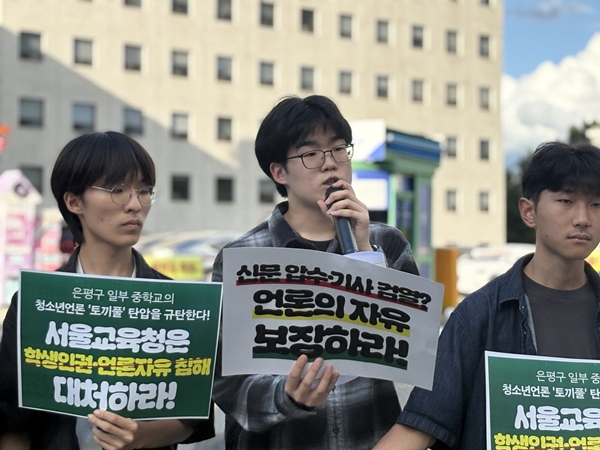
2, on the December 3rd attempted self-coup reads: “The middle school social studies textbook defines democracy as a political system governed by the majority of citizens, not a powerful few” (Tokipul, 2024). This was written by Moon Sung-ho, a fourteen-year-old editor-in-chief. According to journalist Shin Sun-young, who covered Tokipul, Moon and his friends started a school newspaper club in April 2024. It began as an after-school activity then grew into an independent youth press with 32 student journalists from four schools in Eunpyeong district in Seoul. Tokipul now publishes 2,000 copies a month, distributed across those four schools, and runs a website (Shin, 2025).
Earlier that year, before the editorial on December 3rd, Tokipul reported that Seoul’s transit subsidy programs left out youth benefits. After the story ran, Seoul revised its policy to include them.
That summer, Tokipul made news in a different way. Around 100 copies of its 15th issue were confiscated and destroyed by a school administration. The issue had covered climate disaster, youth labor rights, and an interview with a member of the German Bundestag. Tokipul filed a formal information disclosure request to find out why. Two months later, they held a press conference outside the Seoul Metropolitan Office of Education, demanding that it guarantee freedom of the student press and establish clear guidelines on expression. The issue after that was a special edition on press suppression. And in January 2026, another youth press emerged in a different district.
Tokipul raises the question of who speaks, and there is also the question of how things have been told. In the interview with freelance journalist Gatool Katawazi (2026), Nigerian journalist and author Moky Makura describes a realization from watching Live Aid as a teenager in 1985. As artist after artist appeared on screen with the message to donate money and save Africa, Makura felt the vast gap between the image the world was projecting onto Africa and the reality of living there.
According to research by Africa No Filter, a nonprofit organization where Makura serves as an executive director, international media coverage of Africa revolves around five dominant frames: poverty, corruption, conflict, disease, and lack of leadership. Makura explains, “From these five, three deep-rooted narratives emerge. Africa is broken. Africans are dependent. Africans lack the agency or capacity to improve their situation” (quoted in Katawazi, 2026).
However, Makura notes this doesn’t necessarily come from malice. It’s built into the way journalism works, always gravitating toward what is wrong, and after decades of the same stories, even African journalists themselves are affected. According to Africa No Filter’s report
The Cost of Media Stereotypes in 2024, the consequences go beyond perception. The dominant negative image of Africa costs the continent an estimated $4.2 billion a year, because lenders assess Africa as high-risk and charge interest rates accordingly (Katawazi, 2026).
Africa No Filter advises journalists, researches entrenched clichés, and advocates for more diverse and accurate coverage. Makura says what’s needed is better stories, told better. Not “positive stories”, Makura adds, it’s not about promoting Africa, but about stories that do justice to the people working toward progress. Makura puts it this way, “What if all 54 African countries were covered in the same level of detail and nuance as the US or Europe? The world would be completely different. There would be a deeper understanding of the continent and greater tolerance for the challenges they face” (quoted in Katawazi, 2026).
Yet these efforts to tell better stories, to break out of entrenched frames, still takes place within existing media structures, such as editorial judgment, news values, advertising revenue, algorithmic competition. When Rob Wijnberg founded De Correspondent in the Netherlands in 2013, it was an attempt to design that structure differently. Starting with a Kickstarter campaign, it has grown into an ad-free independent journalism platform supported by more than 63,000 paying members. It does not put up a hard paywall. The principle is that it should remain accessible to those who cannot afford a membership.
De Correspondent runs no ads. Ad-based media needs clicks and time on page to survive, and within that structure and pressure, even the most well-intentioned journalist cannot fully escape that market logic. So its member-supported model breaks it. But more interesting difference is in how the platform has designed the relationship between readers(members) and journalists(correspondents). In its manifesto, principle 5 states: “We see you not as a passive news consumer but as an expert who can contribute valuable knowledge” (De Correspondent, n.d.). Correspondents are introduced not as beat reporters but as specialists in a particular subject. And among the members, there are also people with knowledge and experience in that subject. Correspondents explore topics together with their members, sharing research questions and story ideas to get feedback, and the knowledge and experience of members feeds back into the reporting.
In conventional media structures, information flows one way, from journalist to reader. And the reader filters it through existing beliefs. De Correspondent is trying to change that dynamic. The reader is not just a consumer of reality but someone who helps construct it.
Wijnberg’s paradox is about the distance between information and reality. These three cases show how that distance is made and how it can change. A reality that has long been spoken about only in one way becomes a frame, and that frame has real consequences. When people who have always been spoken about become the ones doing the speaking, in their own language, their reality moves. And when information no longer flows in only one direction, the reader stops being a recipient of reality and becomes someone who takes part in shaping it.
I’ve always thought dialogue is a bit overrated. It seems like whenever people worry about polarization, the go-to prescription is dialogue. “Let’s talk. Let’s meet. Let’s try to understand each other. (...)” But as Brandsma (2025) points out, dialogue is not a magic word. What kind of dialogue, between whom, and when it happens all matter. Dialogue at the wrong time, with the wrong people, in the wrong way can actually fuel polarization, no matter how good the intentions.So what kind of dialogue then? According to Brandsma, the group that actually matters in the dynamics of polarization is not the extremes but the middle ground. The silent majority, the people who haven’t chosen a side. Brandsma argues that this middle ground determines which way polarization goes. The dialogue Brandsma describes is not one that tries to persuade people to take a side or adopt a position. It happens in the space where you connect with that middle ground. It’s a dialogue where the ownership of the narrative is shared, where the other person’s experience becomes yours and yours becomes theirs.
Wijnberg (2023) has a different diagnosis for our time, calling it a “post-progress” era instead of “post-truth.” It’s not that truth has lost its power, but that belief in a better future has. Wijnberg notes that nostalgic nationalism, the far-right worldview that promises to return to a simpler past which never existed, moved into that gap not because it was true, but because it offered a coherent and imaginative narrative. And fact-checking can’t compete with that. What can counter the post-progress narrative, Wijnberg argues, is a new narrative of progress. Not a list of things we must not do to prevent the end of the world, but a story about a better world for us and those who come after. A narrative that revolves around connection instead of selfishness, cooperation over competition, collective capacity over individual choice. One that treats knowledge and information not as a commodity for individual consumption but as a public good that builds a shared reality.
And that is not how gospel works. Gospel is one-directional. Whether you receive it or choose it yourself, ownership stays on one side. The narrative Wijnberg describes is shared. As it is in the dialogue Brandsma describes, where the ownership of the narrative is shared. As De Correspondent designs its readers to be participants. As the middle school students of Tokipul critique martial law with their class textbook.


.jpg)